
Automation and Dispatching Systems
Modern buildings, industrial facilities, and engineering networks require continuous monitoring and rational resource management. Automation and dispatching systems (BMS — Building Management System) enable the integration of all engineering systems of a facility into a single intelligent complex.
What does the implementation of automation and dispatching provide?
Energy efficiency and savings: optimization of electricity, heat, and water consumption reduces facility operating costs by up to 20–30%.
Centralized 24/7 monitoring: collection and display of data on the status of all engineering systems on a single dispatcher screen in real time.
Rapid emergency response: automatic detection of failures, leaks, or deviations from normal parameters with instant personnel notification.
Automation of routine processes: minimization of human factor impact through operation based on pre-configured scenarios.
Extended equipment service life: balanced equipment load and timely detection of component wear.
SmartSec offers comprehensive solutions for the design, implementation, and maintenance of automation systems (APCS) and dispatching for business centers, shopping complexes, industrial enterprises, and residential facilities.
Systems we integrate and automate
We integrate the following engineering systems into a unified dispatching network:
Ventilation and air conditioning (HVAC):
Control of temperature, humidity, and air quality (CO₂).
Automatic control of supply and exhaust units and chillers/fan coils.
Heating and heat supply:
Management of boiler rooms, IHP (individual heat points), and pumping stations.
Weather compensation and daily/weekly temperature schedules.
Power supply and lighting:
Monitoring of electrical network parameters, consumption metering.
Control of internal, facade, and outdoor lighting (DALI, presence scenarios).
Monitoring of DGU (diesel generator units) and UPS systems.
Water supply and drainage:
Monitoring of network pressure, reservoir levels, operation of drainage and sewage pumps.
Leak protection and automatic water shutoff during emergencies.
Integration with security systems:
Interaction with fire alarm systems (smoke extraction, evacuation route unlocking).
Integration with access control and video surveillance systems for comprehensive building management.
SMARTEH EQUIPMENT
Main control unit
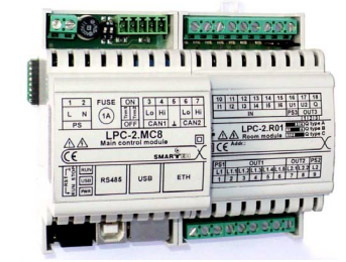
The main controller unit LPC-2.MC8 with Ethernet Modbus network interface is the primary intelligent element in the installed system. It is an open programmable (IEC 61131-3) controller on which the application program operates separately for each room.
The main control unit is used for communication with other controllers and for communication with the main computer. The device is powered by 230 V AC mains. Input and output devices (switches, lights, valves) and communication modules such as the room temperature panel and access control module are connected directly to the controller bus.
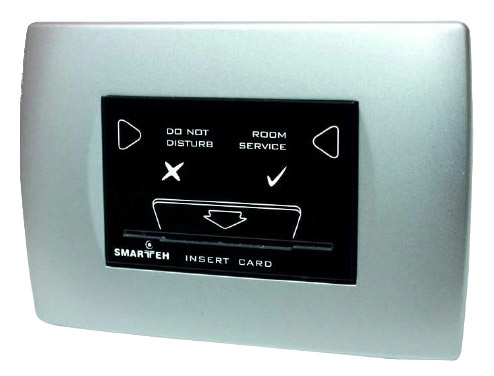
Internal reader with card holder and commands
The internal card holder for electronic keys (LPC-2.CH1) is designed for access control, card insertion, and guest request transmission.
Upon entering the room, the key card must be inserted into the card holder located in the reader. When the card is detected, lighting is activated, the flood control system is enabled, the water supply shutoff valve is activated, and heating is set to comfort mode.
“Do Not Disturb” or “Room Service” signals can be activated using command buttons. When leaving the room, the key card must be removed from the card holder.
The room returns to standby mode; after a certain time, lighting is turned off, the flood control system and water supply shutoff valve are deactivated, heating is switched to energy-saving mode, and other systems in the room are also disabled.
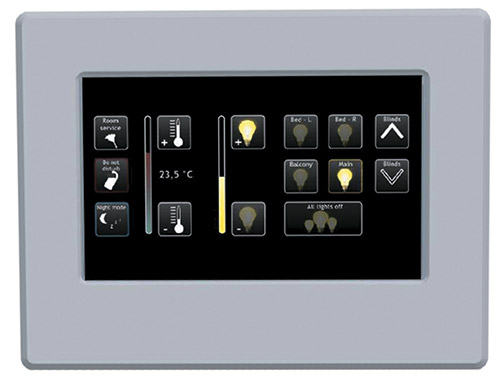
Climate control panel
The room temperature controller (LPC-2.DP1) is designed to regulate room temperature. The device has a temperature sensor, light sensor, and four buttons: temperature “up,” “down,” and fan speed mode selection “up,” “down.” A histogram displays the current status.
With the up and down buttons, we can select the desired room temperature; the setting is indicated by a light position and displays the temperature on the screen. Maximum and minimum temperature limits can be changed via the network.
We can also enable/disable the display of actual temperature, time, or operating mode. Ventilation can be adjusted to constant speeds I, II, III, automatically (AUTO), or turned OFF. Ventilation status is displayed by a light position on the screen. The light sensor controls display intensity so that screen brightness does not disturb the guest during rest.
Integration with external systems
SMARTEH equipment is the lower hardware execution level of the system, which can operate independently, but this is not sufficient for full functionality.
Therefore, SMARTEH provides the capability for integration with other systems.
A complete complex consists of the following components:
- Hotel Management System (HMS) or Technology Management System (TMS)
- Access Control System (guest and service)
- Building Management System (BMS)
- Dispatching system
Advantages of SmartSec solutions
Individual approach: development of solutions tailored to the specifics of your facility — from a small office to distributed industrial infrastructure.
Open protocols: use of standard data transmission protocols (BACnet, Modbus, KNX, LonWorks), ensuring scalability and independence from a single vendor.
User-friendly interface (SCADA / Web interface): intuitive graphical mimic diagrams accessible via web browser or mobile application.
Analytics and reporting: automatic generation of reports on energy consumption, emergency events, and equipment operating hours.
Project implementation stages
Audit and technical specifications: facility assessment, analysis of existing engineering systems, and requirements formulation.
Design: development of working documentation, selection of controllers, sensors, and actuators.
Supply and installation: assembly of automation cabinets, cable routing, equipment installation.
Software and commissioning: PLC programming, SCADA system configuration, testing of all operating modes.
Service support: technical maintenance, software updates, and operational assistance to the dispatching service.
Want to optimize costs and increase facility reliability?
Contact SmartSec specialists for consultation and calculation of automation system efficiency for your business.